
Recently, someone in a conversation I was in casually alluded to the 15 point IQ drop over one’s lifetime. I subsequently spent about five hours finding and reading papers on what lifetime cognitive decline looks like. I had a “whoa, I can’t believe I didn’t look this up and take it into account when planning for my life and interacting with older people” feeling.
I’d noticed that fiction authors drop off noticeably around their sixties (but maybe the thing they were losing wasn’t intelligence per se), and that all my peers’ parents I spoke to in depth seemed noticeably dumber than their children (this one I thought was regression to the mean on the parents’ part). But it didn’t occur to me that the default decline was of the magnitude where, if it happened to you instantaneously in the prime of your life, you’d maybe have to find another friend group. It is. People at age 70 will overall have lost ~10 IQ points compared to their prime. People at age 90 will have lost ~20.
Decline varies a lot by sub-skill even before you get into the difficulties of measurement. Some things you peak at in your teens, others when you’re 30, others when you’re 50. I would have liked knowing these numbers in my twenties, confused and scared by the mental changes I was experiencing. And it’s helpful to me now, forming a realistic picture of what projects I’ll be capable of when I’m 40 or 60.
The big picture view of cognitive decline
I asked ChatGPT Astra for the papers on this subject that had the best methodologies and highest sample sizes, selected and read 3-4 of those papers, and tried to make sense of what I was seeing.
So here’s the issue with estimating cognitive decline. The studies with the most samples snapshot a large number of people at a single time. But they’re weak to the Flynn effect – people born more recently perform better on most subtests, quite substantially, so these studies will overstate decline.
Longitudinal studies, on the other hand, follow the same people over a long period of time. You obviously want the latter when reasoning about what’s going to happen to you. But dropout rates are high and the people who remain are non-representative – they tend to stay on top of their mail, and alive. (But maybe you stay on top of your mail, enjoy taking tests every seven years, and are pretty healthy, so their numbers are predictive of yours.) I expect these understate cognitive decline.
But actually, I don’t think this is too big of a problem in understanding the shape of cognitive decline. The good longitudinal studies and the good non-longitudinal study I looked at don’t disagree that much.
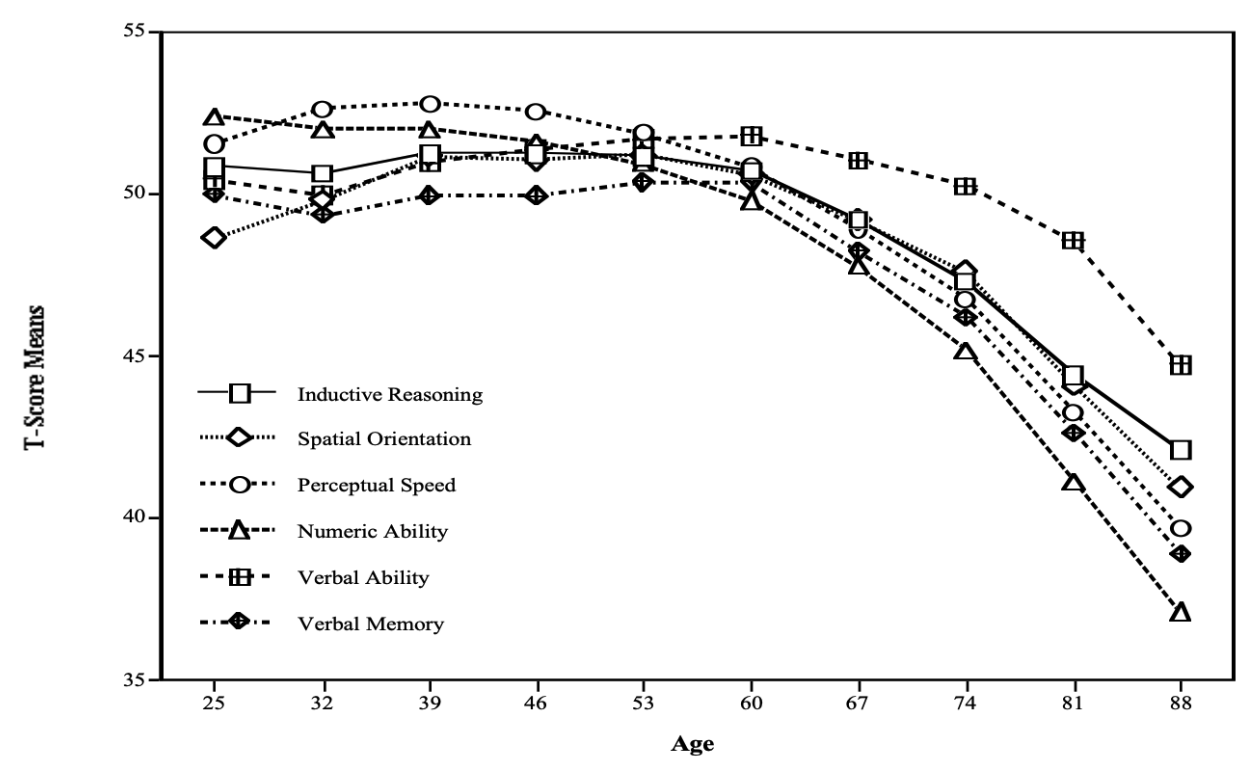
Longitudinal: The “rosy” picture, from the Seattle Longitudinal Study. A T score has a standard deviation of 10, so you can sort of think of a drop of 10 being like a drop in 15 IQ points. (If you don’t have a felt sense of a 1 standard deviation or 15 IQ points in cognitive abilities: In a classroom of 30 random kids, the smartest one is about 1SD smarter than the 5th or 6th smartest, who is in turn about 1SD smarter than the average kid.)
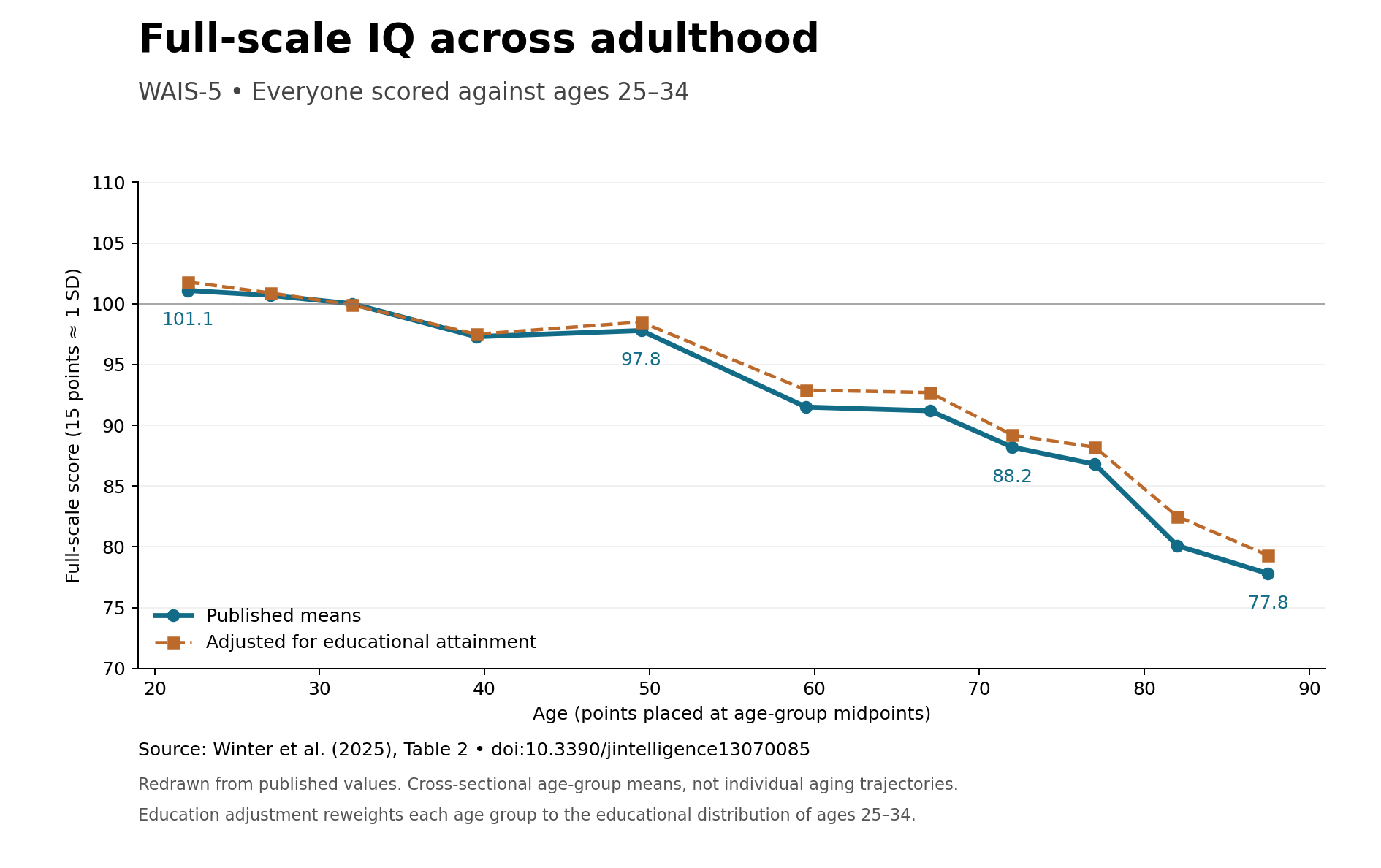
Studies at a single point in time: Surprisingly, none of these give a visual as neat as the one above. Cognitive Aging Revisited contains the right data but doesn’t visualize it, so I asked ChatGPT Astra to do it. I’m sorry to give you an LLM-generated graph; I asked a different Astra session and Claude Fable to re-do the graph (after asking them whether the data in that study could validly generate this graph), and they produced basically identical visuals.
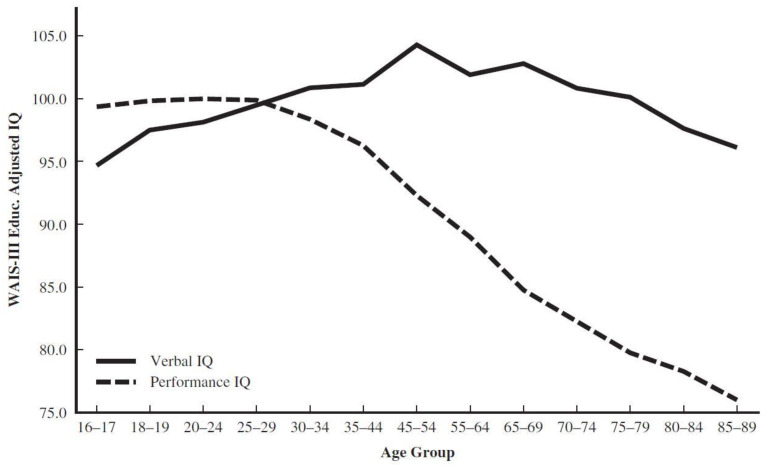
Third is a visual directly from Kaufman 2021, another single-point-in-time study. The author split out IQ results into two – the robust-against-aging stuff that he calls ‘verbal IQ’ and the fast-decline stuff he calls ‘performance IQ’. He himself says they are “…crude amalgams of multiple abilities. V-IQ measures Gc, number ability, and memory (including working memory), whereas P-IQ assesses reasoning, speed, visual-spatial processing, and dealing with novelty”.
So, to try to synthesize these gracefully:
- Some people don’t have noticeable cognitive decline (including on fairly youthy seeming things like shape rotation and math) until 60.
- On full scale IQ (i.e. the score people normally mean when they say IQ): By the time you’re 60, you’ve lost 0-10 IQ points compared to your prime (but lost 15 points’ equivalent on certain subskills, see below). At 70, you’ve lost 5-12 IQ points. By the time you’re 90, you’ve lost 15-25 IQ points.
- As we’ll see below, for certain flashy abilities, you peak before you’re 20. Your ability to work on novel problems declines a lot after you’re 40. Your ability to keep solving problems using what you’ve learned stays pretty stable, with a gentle peak at 50 to 60. Full scale / composite IQ decline figures will underestimate your decline on some axes and overestimate it on others.
More fine-grained breakdown
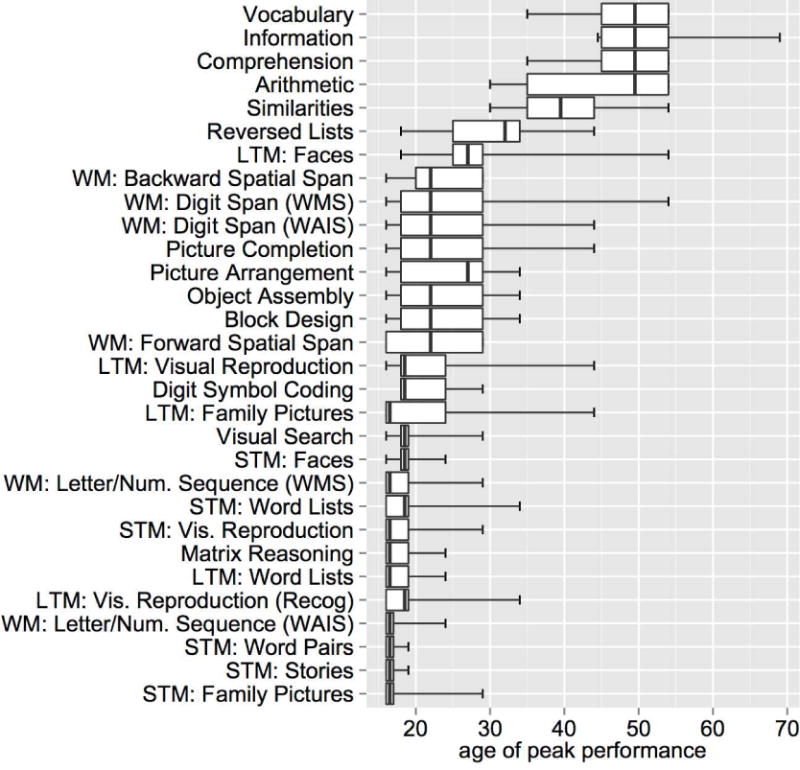
All the graphs below are from When does cognitive functioning peak? – Hartshorne and Germine, 2015. It had 48,000 participants (twenty times larger than the studies the previous visualizations are from) at the cost of sourcing them from the internet. The authors ran a more normal, non-web study in parallel and achieved converging results, and thus argue the web sourcing didn’t matter (since you’d expect confounders like older adults having less experience with computers). But I didn’t look in detail at how convergent the results were.
Here’s a visualization showing when performance peaks for various tests. The unit of the y-axis is standard deviation, so a drop from 0.5 to -0.5 is sort of like a 15 point drop in IQ.
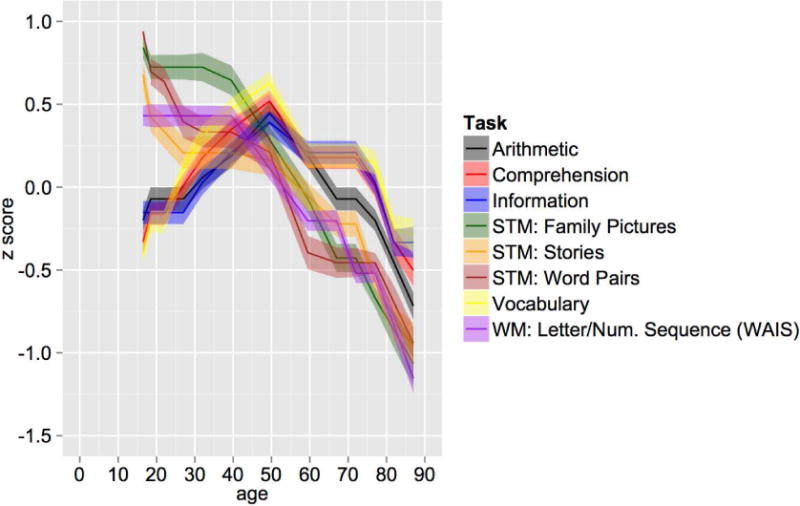 Non-obvious labels:
- Comprehension (peaks at 50): Explain why things happen (ex: why do we have a parole system?)
- Information (peaks at 50): Answer general knowledge questions
- STM Family Pictures (long peak in prime): Exposed to scenes of family activities. Asked to recall which characters were in scene, where they were positioned, and what they were doing.
- STM = Short term memory, i.e. tested immediately after stimulus as opposed to 20-30m (which they label long term).
- Stories (peaks in teens, declines fast): Two stories, read by examiner. Then retell the stories
- Word pairs (peaks in teens, declines fast): Learn lists of word pairs. During test, one word is provided and the other must be recalled.
- Letter/Num. Sequence (long peak in prime): Given list of interspersed numbers and letters. From memory repeat numbers in ascending order then letters in alphabetical order. This task was included in both WAIS and WMS
I’m surprised arithmetic peaks late, since I noticed decline in this in my early twenties and freaked out. I wonder if it’s because most people don’t do much math in their teens, and are practice-bottlenecked. Their scores rise as they calculate tips or make budgets, which drives gains throughout their adulthood even though fluid intelligence is decreasing. But if someone does a lot of math throughout their childhood, arithmetic peaks when their fluid intelligence peaks?
Another visualization showing the spread in peak ages:
Some more expansions of tests of interest to me (full list here):
- Similarities (peaks at 40): In what way are pairs of items alike (ex: fork, spoon)?
- Reversed Lists (peaks at 30): Produce memorized lists (ex: alphabet) in forwards then backwards as quickly as possible
- I’m surprised this one peaks as late as it does.
- Faces: Exposed to faces for 2 sec. each. Then discriminate these from novel faces
- Backward Spatial Span (peaks in 20s): Tap a set of cubes in reverse order from experimenter
Another one:
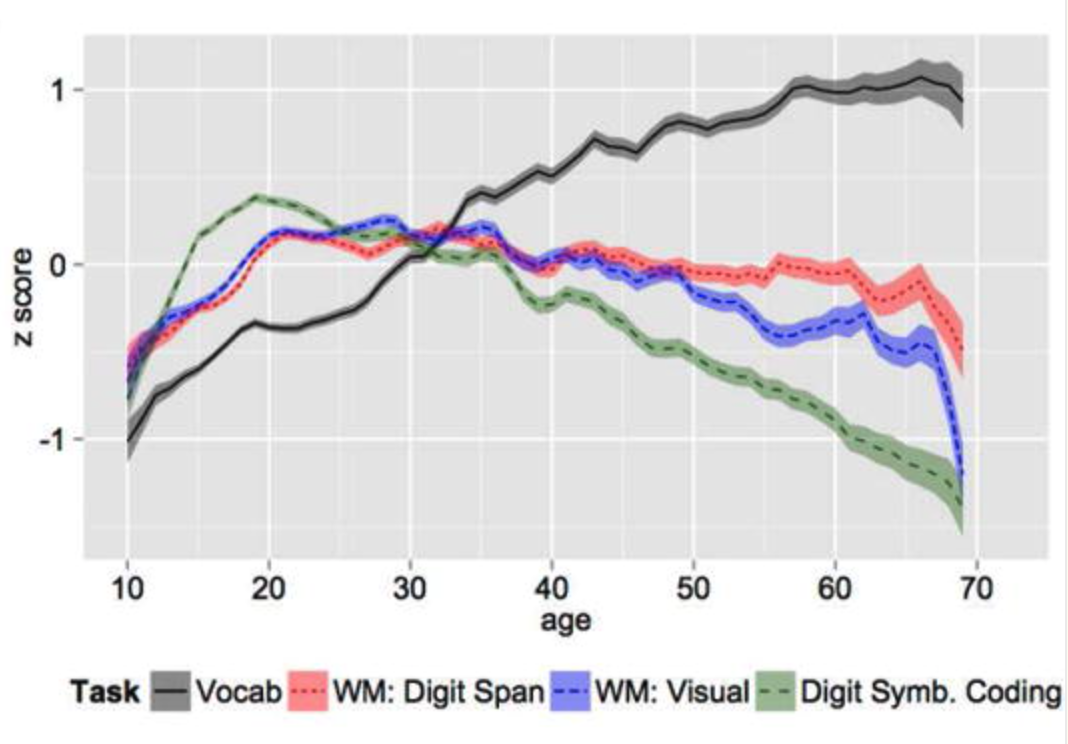
- Digit Span: Repeat lists of digits, either in same order or reversed order.
- Visual: A speeded visual search task
- Digit Symbol Coding: Digits 1–3 are each paired with a symbol. Given list of symbols, write down corresponding digit as fast as possible
Again, the y-axis unit is standard deviation - so for the most dramatic decline in digit symbol coding, you’ve “dropped 15 IQ points’ worth” by the time you’re 50, compared to your peak at 20.
What this changes
Writing fiction
In my 20s, I had a lot of crazy ideas for novels. In my early 30s, I noticed I spend a lot more time revisiting those old ideas than coming up with new ones – c.f. my post on incomplete projects as resources. I think it would be a good strategy to take this even further. My crazy premise generator peaked in my twenties (empirically). I expect my skills at basic execution and prose to remain good into my sixties. And maybe my ability to craft good and interesting plots will peak in my thirties and forties.
So I can play the long game and distribute a bunch of novels over decades. I have dozens of cool ideas now. I can spend the next decade refining them in parallel and solving the key problems in the plot without taking (most of) them to completion, and spend a few decades after that polishing them into final products. I think this would be a bit of a crazy way to work, but I’m intrigued by the notion.
Planning for productive old age
I was at an art gallery a few years ago admiring some actually good paintings. I heard someone (I think the gallerist) say to a guest, of the painter: “She’s only forty(-something). She’s just hitting her stride.”
I was thunderstruck. I had never heard anyone say this before: that someone at that age is just hitting their stride at something. But it seems true to me. I’ve been writing fiction and drawing intensively since I was eleven, and I instinctively know which of these things I’ll be able to do – and do well – when I’m 70. Writing seems to draw on a brilliance or mania or something that I just don’t see in the 70-year-olds I talk to.
So even though painting is not a domain I admire, and I’ve often regretted investing in something so low-value1, I’m glad I have it as a stable base for when I’m older.
My parents’ generation
I feel nicer and more patient.
Reframing my twenties
In my mid twenties, I noticed I was slower at calculating tips, and otherwise made little mistakes that I couldn’t remember making before. I freaked out. I thought there was something wrong with me. I spent a few hundred dollars on nootropics trying to counteract whatever was happening.
My understanding is now that (1) I was experiencing inevitable, non-pathological cognitive decline, and (2) I did fall off a little harder than average. I think my mom fell off unusually hard as well – her relative-to-other-adults cognitive abilities at age 50 were hard to square with minor academic awards she said she won as a child.
I tried to talk to other people about what was happening. They often did acknowledge that everyone slowed down as they aged, but… it didn’t seem like they were talking about shattering loss, like they had become a bit disabled. Like a medium that they’d used to swim in with perfect ease had clouded up and filled with random little stingers that paralyzed you when you were trying to do a flip.
In my teens, I would play little games by memorizing arbitrary information and then recalling it perfectly later in the day when I saw the trigger object I’d decided to associate with the information. I enjoyed exams as much as many people enjoy video games. Now, I walk from room to room trying to remember what chore I was doing. I left the oven on after dinner the other day.
I’m a little confused by why grief about this isn’t more of a… universal narrative, like the way your first breakup is a universal narrative your culture helps you get over. People tell twenty-somethings all the time about how it’s all downhill from here about physical health. But what about that crystal clarity, that perfect memory? My teen self seems stupid to me in many ways, but the stupidity was characterized by ignorance (often willful ignorance) – not confusion. Now, it is the other way around. And confusion is painful in a way ignorance was not.
I wish I could tell my past self: “The mental motions you most enjoyed were disproportionately the ones that peak in one’s teens. You might also be declining faster than average. There is nothing you can do. This will happen with other things, too. Orient to it.”
Footnotes
-
1. I’ve run polls on this and the majority of respondents broadly agree that paintings don’t provide peak life experiences the way music or fiction does. Ah, visual art. you can spend weeks on something that most people take in and dismiss at a glance.