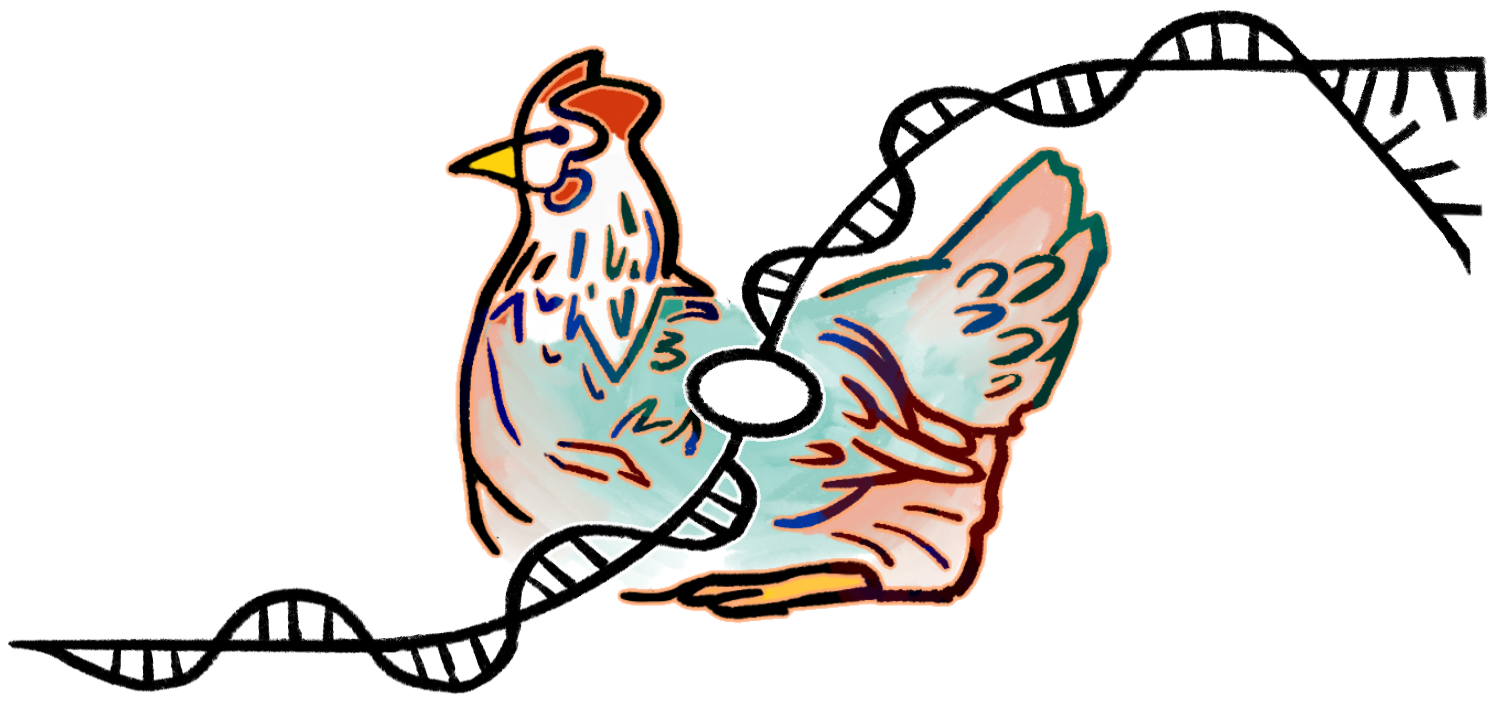
At Inkhaven, I participated in a group challenge to write 500 words on a prompt (“the last echo”) in 30 minutes. The timeline is based on notes I took on a book on ancient human genetics, some details are from ChatGPT and Wikipedia and the published papers both of them linked to, and much of it is liberties.
Even if every single fact were technically correct, to narrativize the diffuse effect of trace amounts of hybridization is to depart from a true account of events.
650,000 BC
Some of them went north. The climate different, the animals different, the sicknesses different. Different and more. They got sick and recovered and got sick and died.
Lot of burials. Millennia of care. Shallow pits sprinkled with ochre, an eagle talon or two. A little bit of beauty or fierceness.
The harsh continent winnowed down their population. Their germline – the one eternal cell lineage of eggs-or-sperm and germ cell – homogenized from inbreeding. Their bodies, the disposable soma, grew and killed and cooked and laughed and kissed babies and buried babies and died.
(Almost everything in your body is designed to die. Only a tiny thread in us, in our ovaries or testes, is meant to go on forever, singing its song of ATGGAGCAGCTGCGAGCGCC…)
60,000 BC
Now some of us went north too. We skirted the Red Sea, followed the warm coastline of Arabia, then radiated north and west and east from the Persian Gulf. We were a dark, curious people, with a low tendency to fever or inflammation – chronic inflammation is metabolically ruinous. But we ran into the same problems. The new diseases.
It would have been better to heat up swiftly, to flood our blood fast with poison. Burn it out, hurt ourselves, but live. Instead, more graves, more animal bones or red powder. The dead ones were precious, so we put precious color on them before covering them up.
Of course we found the others, who’d been here in Eurasia thirty thousand generations longer. We killed, shared food, and screwed. Sometimes we killed the babies their men put in our women. Sometimes we raised them. We watched each other make awls, hides, hafts, hand stencil art. We watched their babies survive sometimes when ours did not.
40,000 BC
Skies darkened. Food scarce. Less fucking and sharing food. More killing. They didn’t speak so well, didn’t coordinate so well, didn’t share knowledge so well. We could make plans, talking about contingencies. If they’re here, strike from there. Herd them here, and kill them there. Talk talk talk. Ambush. Kill whole families in one strike. Take their awls and hides and land, its fading berries and deer.
What were we supposed to do? We had our own siblings and children. Our frail parents. It was us or them. Some of us had a hint of their nose or brows, but us was us and them was them.
After a while we noticed we hadn’t seen them in a while. They were a grandfather-story, and then just a story, and then nothing.
We ambled over into the Yellow River basin. We quickly shed most of their genes. Particularly on the X chromosome, where anything foreign tended to cause infertility. Very little of them left there. Little of their nose or brow. None of their brains, we didn’t want their brains. What was left didn’t show much. But what was left, we kept.
1856 AD
We were fucking around in the Neander Valley when we found their bones and grave-gifts. We’d forgotten about them. They looked basically like us. It wasn’t so obvious how funny they’d looked, how weirdly they’d walked, how badly they’d spoken. Bones look the same unless you’re a bone guy.
Much later, we unwrapped the otic capsule in the inner ear. The hardest bone in the body where DNA is best preserved. It kept their story for a long time:
Now you listen. I can tell you a little bit of it. Not the kisses or heartbreaks or the family naps sprawled on fur rugs after a big barbecue. I only tell germline-stories. I, little earbone, heard their bodies live, but not in any way I can relate to you. On the soma-stories, I keep my silence.
2010 AD
When we started reading our own genome, it was clear most of us had a bit of Neanderthal in us. Africans didn’t, but Europeans did a bit, and East Asians a little more. Zero or one or two percent. Two percent – of what? Immune and metabolic stuff. Some skin and hair stuff.
The Neanderthal version of the STAT2 gene reacts more quickly and violently to viruses. The OAS proteins shred viral RNA – and some of your own. Neanderthals had a more aggressive response. The TLR family of proteins raise the cytokine alarm when they detect bacteria, especially on the skin.
The East Asian genome is only 2.3% Neanderthal, but almost half East Asians have the more sensitive Neanderthal TLR.
2025 AD
“Achoo!”
“Bless you.”
They always say bless you early, not realizing I’m just getting started. “Achoo! Achoo! Achoo!”
My backpack always holds Zyrtec, Allegra, the usual allergy meds. And Flonase, a steroidal spray for my nose. And boswellia serrata, a random anti-inflammatory that’s even better than Zyrtec at suppressing serious allergy attacks, the ones where I sneeze twice a minute for hours. And hydrocortisone and triamcinolone for eczema. And bandaids for my knuckles and elbow, which get so itchy that I scratch until I bleed. I think I have a lot of inflammation. Tiny grenades in my tissues.
The museum reconstructions tell us how they looked, but the clay of their mouths is mute and there is no beholding in the resin of their eyes. The living echo lies in the way you deposit fat and the way I sneeze and scratch.
But I want to hear their soma-song!
What happened to the soma-song?
Why, there is no echo of that?
There is no echo?
is no?
Is?
No.
was
was
was.