This is of no interest to most people, and of great interest to a few people who, like me, are in the position of placing a large order of shirts from CustomInk. This post does not address whether you should go with CustomInk – they are simply the established vendor at conferences I am familiar with. I think they are a good vendor if your designs are simple. They are a terrible vendor if you have a detailed design containing more than a few colors and don’t know ~8 key things they won’t tell you upfront. If you know the things, I think they wrap back around to being decent.
the key things
- If your design fills the whole width of a shirt, left to right, and the image file is 3300 pixels wide, the minimum stroke thickness you can have is about 11 pixels. Anything thinner will get thickened.
- I recommend emailing them (
[email protected]) to say you want a dedicated representative to coordinate a big order. If you do not do this, you will get a different rep every time you email them with a question. - If you order one sample shirt to see how your design looks, this will not be informative because CustomInk uses a higher-fidelity, softer-on-fabric method (DTG) for orders under 6 shirts, and a different method (screen printing) for big orders. Screen printing has an upfront cost for them (manufacturing the screens that ink goes through) but is cheaper at scale, whereas DTG has a linear cost because the shirt just goes under a fancy printer. Unless you’re willing to drop $150 on 6 sample shirts, you should assume you have one shot at getting this right.
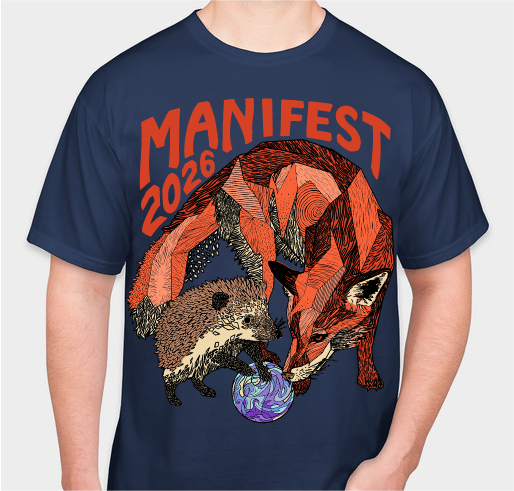
- My design for Manifest this year had 10 colors on the front. That may be close to the maximum they can do, because their recent blog post lists 1-8 ink colors as the desired range for screen printing. (On the other hand, they can handle gradients within a single screen.)
- You can avoid the above two constraints if you have enough time. You CAN get the higher-fidelity printing method (DTG) for a large order, but you need to apply for an exception and they do not do it for rush orders because of the strain on delicate hardware.
- I don’t know what their timeline/count curve looks like, but based on vibes across 50 emails, I’d guess I could have gotten a DTG exception for 700 shirts had I placed the final order 3 weeks before I needed it.
- If you are ordering for a conference, size the image to the maximum or near-maximum width when placing it on the shirt in the design interface. CustomInk does not change the size of the design between a small shirt and an XL shirt. If the design looks small on the S, it will look tiny on the XL. What you see on the interface matches the S. This is true for both DTG and screen printing.
- CustomInk has a “super rush” shipping option. At the ordering interface where they show you the shipping options, the website will say “Get it by Thursday (order by 11am)” on a Monday morning. This is not true! I was given Thursday 9am as the final design submission time for a super rush order that had to arrive the subsequent Thursday. It may be that they have faster turnaround for simpler designs or smaller orders (we were ordering 734) but I would not take the chance.
some more niche points
scaling the design
I said above that “CustomInk does not change the size of the design between a small shirt and an XL shirt. If the design looks small on the S, it will look tiny on the XL”. You can ask for different scales for different shirts (and they don’t mention this is possible until you ask), but this means they have to manufacture extra screens for each scale and this costs more. The pricing information I got on this was:
The cost for the Various Sized Screen service depends on your design’s color count and applies per print location: - 1 color = $25 - 2 colors = $40 - 3 colors = $55 - 4 colors = $70.
I believe this is per additional size.
gaps
Both DTG and screen printing leave a film that makes the shirt stiffer where the ink is applied. (DTG is a bit softer, though.) So, if you have a design with a lot of white and black on it, you might think you can avoid having a big contiguous stiff area by sending them two different PNGs for white and black shirt – one file where the black is omitted, one where the white is omitted, so that the shirt’s color fills in it. This way you have gaps between the stiff areas where the fabric can flex as the wearer moves.
I tried to do this. Don’t even think about it. They want one PNG on all the shirt colors. Once my order was in, they emailed me to say, “The designs are almost identical. We are going to use one PNG for this. We merged the two you sent. How is this?” They didn’t phrase it in a particularly negotiable-sounding way, so I dropped white and only ordered navy and black shirts.
I was stunned at this development, because I’d given them two PNGs very early on and they’d never told me they were going to do this. Which brings me to:
CustomInk will not let you talk directly to the technicians who convert your image to a screen printing format. The art techs only give you feedback when you have already paid and are giving them a design to order. So many of these disasters could have been averted on day 1 if I’d gotten to call their techs for 15 minutes and understand their conversion process.
(And yes, I asked at the beginning when I got in touch with a dedicated rep.)
layer order
This one is speculative, but the techs may fuck up the layer order, so if you have a color that is particularly important to be the same thickness everywhere – say, black lineart – you might have to explicitly ask them to put it on the top or bottom. They sent me this proof where the black is weirdly thick on the beige, and weirdly thin on the bright orange. My guess is that the beige is at the “bottom”, so it is partially covered by the black ink that is applied later, and the black ink in turn is partially occluded by the orange.
t shirt sizes
I learned all this (“pain, which cannot forget, falls drop by drop upon the heart until, in our own despair, against our will, comes wisdom through the awful grace of CustomInk…”) while designing t-shirts for Manifest. I thought I’d record some sizing advice for people ordering shirts for a similar crowd: technical, male-skewed, Bay Area.
For ~800 attendees, not all of whom wanted a t-shirt, we ordered, and had left over:
- S: 120 ⇒ none left over
- M: 210 ⇒ none left over
- L: 240⇒ ~10 left over
- XL: 148 ⇒ ~20 left over of XL and up (they were all in a heap at the XL+ table and I didn’t bother sifting)
- XXL: 10
- 3XL: 4
- 4XL: 2
So next year my inclination would be to do
- S: 150
- M: 230
- L: 220
- XL: 118
- XXL: 10
- 3XL: 4
- 4XL: 2
fabric
Manifest has mostly used the Comfort Colors shirt, which is CustomInk’s bestselling / most highly rated fabric. Its sister conference LessOnline uses the Bella Tri-Blend. I like both. Comfort Colors doesn’t make me go “ooh this is soft”, but it has a robust feeling I like. I think the Bella is softer and nicer, but it is thinner. (My bras shine through white Bella Tri-blend shirts.) I expect that it is a worse substrate for applied ink.
PADs
You may see PADs in the invoice: “Please note that PADS are extras the printer includes in case of any issues, you are not charged for them.” Manifest this year ordered 734 shirts and got 12 extra.