
Years ago, a survey called “Johari” (and its evil twin for negative traits, “Nohari”) went around my social circle. You pick the attributes you thought you have, and sent your friends a survey on which attributes they thought you had. After filling out the survey, you all see the 2x2 grid of results: traits you and your friends agreed you have, or don’t have, traits you thought you had but your friends didn’t, and traits you thought you didn’t have but your friends did. This seemed obviously informative, but I thought this would psychologically brutalize me, so I never tried it.
I am currently spending a lot of time on Aella’s vibecoded social media website, glosso.ink. Glosso is half a zone for normal private posting, and half place where a creative and experienced statistician can go ham with social experiments on her high-openness userbase.
The latest is –
Wait, read this post I made there first:
lmaooo Aella has invented the staircase where you hear all the things people have said about you, from Tim Kreider’s “I would never descend the staircase where I hear all the things people have said about me”
– the latest experiment is Rankland, where you rate your friends on various traits (and thereby unlock ratings other people gave for you, as long as 5+ people gave their rankings for a trait). A typical question and its options looks like this:
“Perceptive” describes Bob
- Strongly disagree
- Disagree
- Slightly disagree
- Neutral
- Slightly agree
- Agree
- Strongly agree
- I don’t know
I find surveys actively soothing, and I have no compunction with rating my friends. (Some people say this changes how they perceive their friends or their mood afterwards, but I get none of this.) So after a full day, I unlocked all fifty traits. Here are the twelve traits my glosso contacts thought I most had:
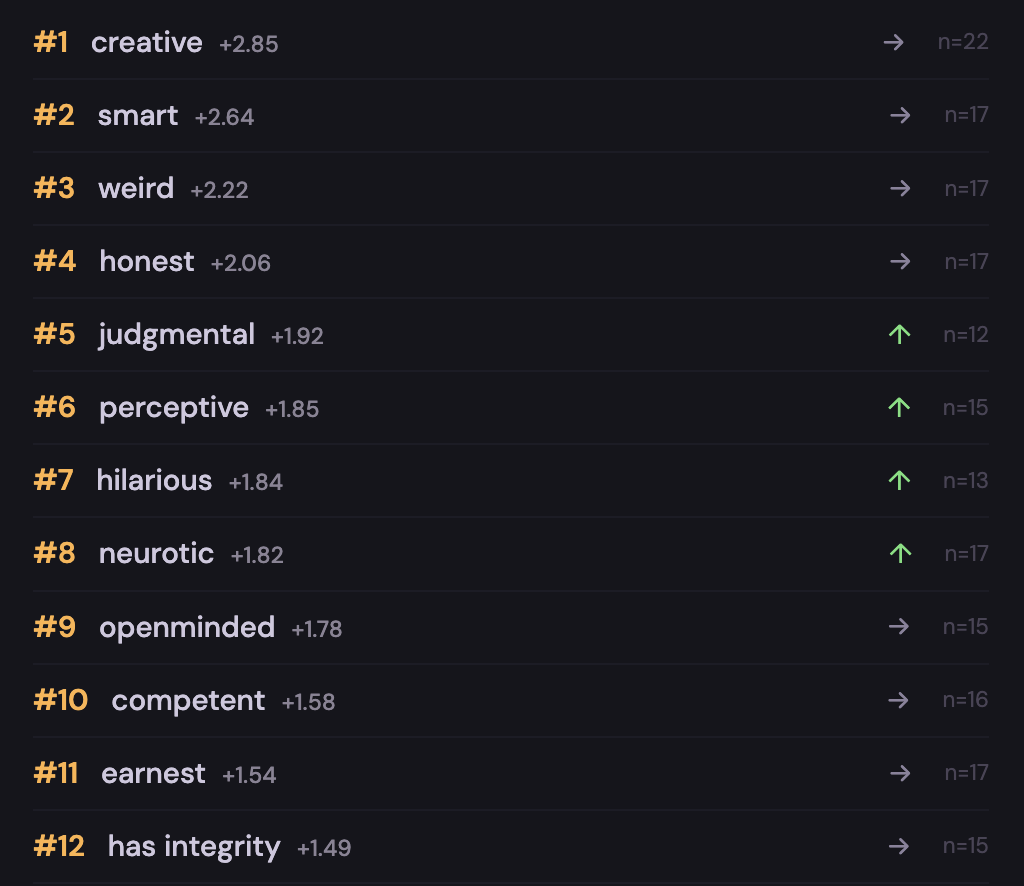
The up arrows mean that people who reported spending more time with me, compared to people who knew me less well, thought I had more of the trait. There are double arrows for strong differences. I have double arrows for [confrontational, feminine, ambitious, adventurous]. (Also more loving and less evil, but I think everyone’s close friends think this of them more than their acquaintances do.)
Glosso’s users are currently a weird bunch, and also everyone says their friends have more positive traits than negative ones anyway. What I care about is ratings relative to everyone else. Here is that list:
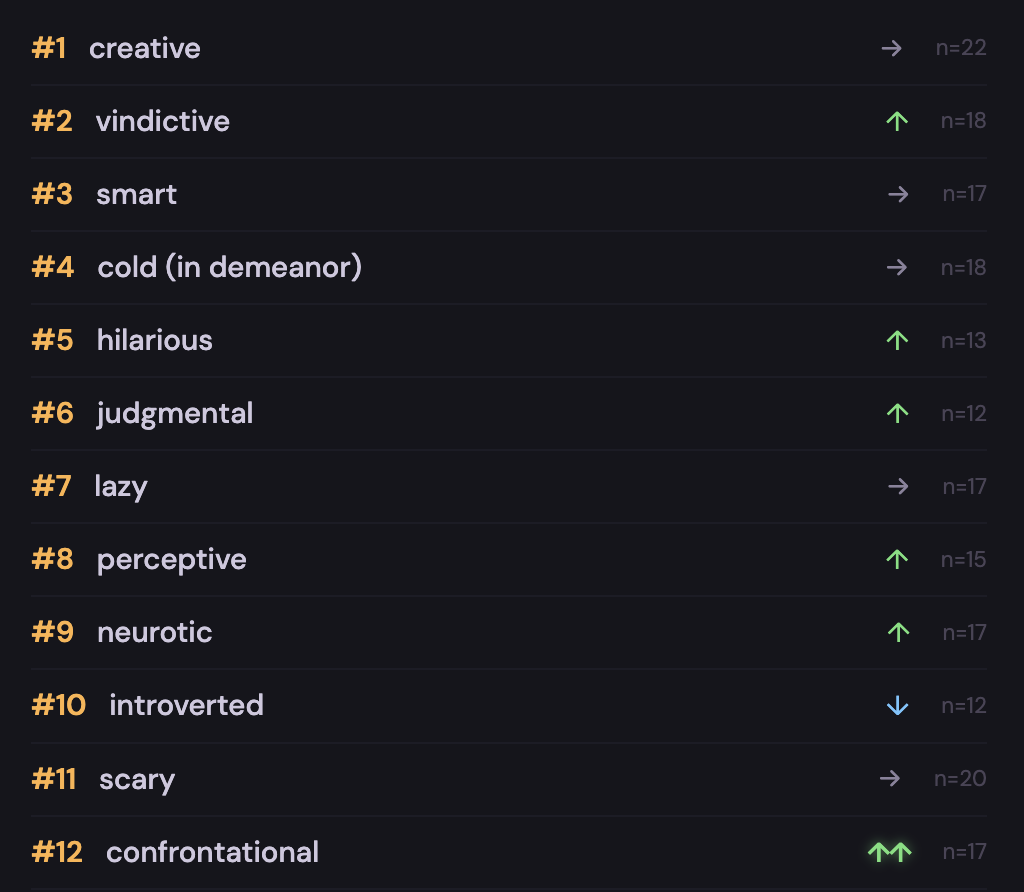
Since there are 50 traits, I naively guess that each trait goes down 2 percentage points as you go down the list – that people rate me as 99th percentile creative, 97th percentile vindictive, and so forth.
the hard parts
I actually hit my first psychological bump seeing the results for a positive trait. Early on I saw a high-seeming number for competence, which was terrifying in an “oh god I’m going to let down my friends who don’t know I suck yet” way. But after comparing notes with a friend who was able to see percentile results, I realized I was near median for glosso, which seemed correct and therefore unscary.
I had several seen-oofs and one unseen-oof. The unseen-oof was laziness, where I have a high-ish relative ranking – my guess is 80th percentile. Insofar as laziness tracks “whether you are unaccomplished”, I think people seeing me as lazy is very fair, but if it tracks “a laissez-faire attitude towards commitments / a disinterest in pouring effort into one’s projects”, I think it’s wrong. I consider my unaccomplished life to mostly be due to flaws other than laziness.
My internal experience of the world is that I wake up most days scheming furiously to overcome myself and make progress on some project. I’m the typical 2016 LessWronger who blogs about akrasia, takes a million supplements, takes LSD to overcome their social-anxiety-based procrastination at their SaaS job, and loses money to Beeminder – all in vain.
ancient greek patriarch
I have a preexisting self conception that these results support, which is that I have a personality that’s more suited to low-cooperation premodern societies than to abundant modernity. I try to hide this, but the more people know me, the more they think I am [vindictive, confrontational, judgmental, generous], and the less they think I’m [compassionate, inconsiderate, selfish].
That’s an interesting update vector. It reminds me of the bit in Plato’s Republic where one of the guys Socrates is mogging defines good as “doing good to our friends and harm to our enemies”. I have an interpretation that this part of me I try to hide (unsuccessfully to close friends) is a decent old world patriarch: fighty and unempathetic, but loyal and generous to his community. This is basically my dad, by the way.
I’m not holding the above interpretation tightly – it seems probable that some of these are updates people generically make when they get closer, and at any rate N=15-20 isn’t that high.
the trip
I’m ~70% done psychologically integrating these results. It feels like I’ve been on a low dose of some psychedelic. 6-7 years ago I didn’t like myself much and would have been too scared to opt in. I spent a lot of today a little dazed, coming to terms with information I already knew.
In aggregate, the people around me agree with me about what my individual strengths and flaws are. But the composite image is still startling. When I reconstruct myself from these numbers, I see someone who’s clever, cold1, judgy – good to have around because they make things interesting, but not because they put you at ease.
I’m taken aback by this view of myself, but I don’t disagree with it, especially when I put it to myself that most other people seem (“weirdly”) warm2, occlusive, and boring.
It’s nice to stop wondering. To let go of the tension of being someone who couldn’t bear to post a Johari link.
postscript from the ego
Early on, before the ranking feature came on the scene, glosso had a “wars” feature where you repeatedly choose which of a pair of your friends is higher on some (nice) quality.
I was really surprised by the results. It led to the single most dramatic update I’ve made on my social position. I’m at the top of the leaderboard for likedness (out of 39, which is small for a war) and near the top on several other wars that seem to load on charisma and respect.
Yet, my perceived charisma is well below average. By the crude percentile estimation described above, I’m in the bottom decile of friendliness, and the top decile of coldness.
A person most efficiently described as “creative, vindictive, smart, cold, hilarious” has to be pretty dang creative, smart, and hilarious to be as liked as I am.
God I must be good at the things I’m good at.
Footnotes
-
1. Note: Even setting aside the diversity of the opinions that produced this final picture, I’m a very different person with my partners and my child.
-
2. As a child I noticed that people are very nice to each other (not as opposed to being cruel, but as opposed to quietly coexisting without asking each other all the time whether they wanted tea or how things were going) and used to feel burdened by having to participate in this niceness arms race to be get along in society. I now ask people whether they want tea and how things are going, and it even feels 80% natural, but I guess I haven’t shed the appearance of a malfunctioning animatronic being remote-controlled while screaming to be released from its hell.