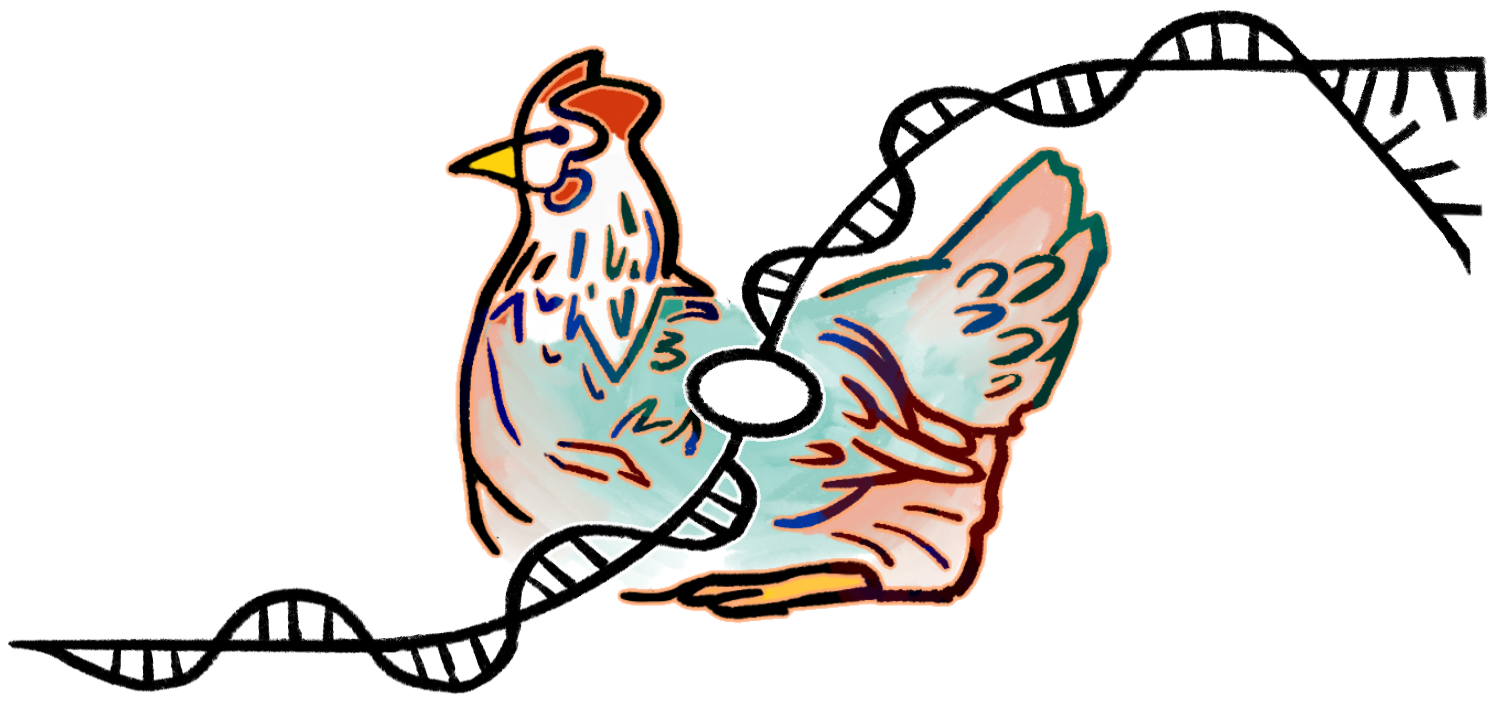
Haswal’s son woke with a great thrash that tangled him further. He had needed waking soon anyway because he was tangled near the point where the planetary pediatric association recommended waking a child up for unsnarling. Haswal dived her head and tail into the crib. Her tail slipped rapidly over the loops of her hissing son, searching by feel for slip points where one quick pull could unravel an entire section, while her head started looking visually for the ends of her son.
Throughout this whole process Eswe jetted venom everywhere in angry, uncontrolled bursts from ducts that ran down his spine. The venom was diluted in infancy, but nonetheless needed to be washed off both of them as soon as Eswe was untangled.
The job was not done after the shower – Eswe was, as usual, so upset about the whole ordeal that Haswal had to twine her whole body around his and hold him still. Then his lower stomach had to be massaged to induce a bowel movement, because they were getting on the bus to visit her friend, and she did not want him to defecate in the bus and lash it around everywhere. Alwess had offered to come to her, but Haswal liked the chance to get out of the house.
Alwess was one of few friends who had kept in touch after Haswal’s egg had hatched. All of Haswal’s friends were childless. It was probably for the best – the government was making noises about putting a hard annual limit on new children. The world’s one ocean was one hyper-engineered and strained fishery.
Haswal carried Eswe with the upper third of her body. Haswal’s squeezing hadn’t quite worked, so when she slithered off the bus, her neck was covered with a film of baby poop. They had to use Alwess’s bath. As they were drying off, Alwess said, “Has it occurred to you that children are weirdly difficult?”
Haswal was frazzled and sarcastic. “It hasn’t crossed my mind.”
Alwess, unperturbed, brought out guest-plates of tartare and milk and continued, “Evolutionarily, it seems implausible that children be so hard. It completely incapacitates parents now. Yet, our species got here somehow. You don’t think it’s… suspicious?”
Haswal sighed. Eswe at least was happy, twined around her neck and flicking his tongue out at the flavored milk. “Suspicious? The world is the world.”
“Hmm,” said Alwess, and changed the topic. They caught up. Old friends were divorcing – Alwess had refitted her den – Haswal had made no progress on her symphony. The last was a sore point. Up until Eswe it had been shaping up to be her best. She had no time or energy to concentrate on it, but she hated to complain and drive away her only real friend. Then Alwess asked the same question she always did: “How are you feeling now about having had a child?”
The regularity of the questioning led Haswal to think Alwess herself was on the fence. Secretly she dreaded Alwess having a child too – Alwess would undoubtedly be too busy then to have a guest over, in this immaculate and clean-smelling house that was Haswal’s main retreat from her own. “Same as ever,” she said. “There are moments of joy – many of them. In between great deserts of despair. I glimpse in Eswe a wonderful person. But… he is a wonderful person who is suffering most of the time, and so in need of incomprehensible and resented interventions.”
Then Alwess asked the followup question Haswal had always dreaded, but had never been voiced between them before. “Do you regret it?”
She had the answer ready. It was just hard to say. “No, in that I don’t wake up thinking I wish I hadn’t done this. Yes, in that if I could do it over again, I… I wouldn’t make the egg. Not when there are twenty more years of this. Being alone, cleaning venom from the walls, untangling him ten times a day, fashioning new entertainment for him from limited materials.”
“Haswal,” said her friend, “I ask you one more time, does it not seem suspicious that children are so difficult?”
She was less annoyed now by the question. “Confusing, certainly. Compared to other animals. But those animals are not sapient.”
“So you think the difficulty is inherent to sapience?”
“No,” Haswal said slowly. “The sapience, or rather its concomitant novelty drive, might explain why they’re so bored all the time – ow!” Eswe had tried to bite her. “But it doesn’t explain why they can’t sleep through the night without getting so tangled you need to wake them, or why their venom comes in so early, or why they lash their tails about after a bowel movement. That last one is such a nonsensical instinct to be born with.”
“Haswal, I’m about to say something absurd, but I swear it is true. The world is not the world. Children are indeed not supposed to be this hard. In the real world, rearing them only takes five years, not twenty. They can sleep a full night before requiring untangling. They lie still after defecation, or slither carefully away.”
“In the real world? Then, what, is this a dream?”
“A dream you entered knowingly, along with many other people who wanted to be parents. Only a few of them will be permitted to, because the world’s population cannot grow further given new wintering pods that extend lifespans.”
“I heard those were starting to see real use!” Haswal exclaimed. “But I they seemed too good to be true – living three hundred years because cell damage is repaired during hibernation.”
“It is more than three hundred. This dream was placed quite far in the past, before the pods became universal and reproductive restrictions were installed. The news articles and medical journals sprinkled around the dream say three hundred, because the dreamers would not believe it otherwise.”
Haswal thought out loud. “So only a few people can have children. Everyone who wants them is put in this dream, because…” A wave of sadness rolled over her. “Because who gets to reproduce is determined by who still wants to, when children are more difficult to raise. Implausibly more difficult. And I haven’t made the cut.”
“No,” said Alwess gently.
Haswal flexed her neck to heft her dream-child up higher and look at his face. “Oh, Eswe,” she said sadly. And then: “Has he suffered for real? He has been mostly unhappy since the day he was born.”
“Not a bit,” Alwess assured her. “In this dream, only you and I are real. You have spent a year here now. I’ve only spent a few days’ worth of time here, talking to you. We are friends in the real world, and I’ve been trained to support you through the transition once we’re back.”
Eswe wound sleepily around her. He had always been strangely easy when visiting Alwess. Haswal said, “Surely some… people… don’t want to wake.”
“Some. They are allowed to stay. The dream will ease up – that is, the child will become easier. But there is still no animating consciousness there, and eventually the parents get tired and ask to leave. Are you considering it?”
“Not seriously. But – you see – it’s also unthinkable to leave him. Even knowing.”
Alwess said, “When you agreed to enter this dream – this, you know, quite insane dream with a lot of consent forms – part of the terms were that your feelings for him would be magnetically excised. There’s a machine around your head in the real world right now. It will start when you are ready.”
“Oh,” Haswal said. “Will it happen all at once?”
“The change is gradual across a few minutes. Would you like several more days with him? Or would you like it to happen once you are out of the dream?”
Haswal thought.
She thought for a long time.
“I’m ready now,” said Haswal, and watched and held her son with the utmost focus as he became a mere weight around her neck.
She set him down gently. Shadow child, vessel of false pain, a test she had failed by not having enough love in her. She marveled at the absence of feeling for his familiar coiled form. She knew she’d felt a yoked, anguished love for him – but she could not remember the feeling itself, only the words to describe it.
There were a hundred things she could say. She chose at random. “This was such a strange experience. I don’t suppose I could write music about it.”
“It’s been mined to death, I’m afraid.”
Haswal shook her head in amazement.
“Anything else you want to do before you wake up?”
Another long pause. “No. I’ve lost a year of my life in this dream. That’s enough. End it.”
“Don’t worry about the year. You get ten thousand,” Alwess assured her.
Ten thousand!
The world around them began to shimmer and lose detail.
Alwess said, as they waited, “I am sorry you cannot have children.”
Haswal had shoved that thought away. She had to turn it over alone before she could talk to anyone else about it. She said, merely, “The obverse side of the lifespan. There is a tragedy and there is a joy. Both are too large to digest right now. I’ll take them in chunks.”
The room wavered and paled and somehow rotated so that Haswal was lying down. Alwess seemed to shift position closer and up, as if she were sitting next to – oh, of course Haswal had been in a bed for a long time. The whole time. But the biggest adjustment was the jumble of concerts and lovers and feuds and friends pouring back into her mind – many more centuries of memories than she’d thought a life could hold. She had – good god, her agonizingly stalled symphony was complete. She could run the whole thing through in her head. She’d completed it in her youth, and it had made her moderately famous at the time. She had done much more, and better, work since.
Oh, Eswe – oh, world of so few children –
Alwess’s dream house fell away entirely, and Haswal awoke to ten thousand years of making music.