Here is my story of Argentina. My credentials are that I spent the first three hours of my flight to Argentina reading its Wikipedia page plus followup google search results.
Argentina was rich. Then it became poor for no clear reason. It could become very rich again.
Let’s start with the last one.
Argentina is a major agricultural exporter that’s not even tapping its full biocapacity. Without making any prescriptive statements about whether they should, it’s descriptively true that they could be leaning on their natural resources much harder than they currently are.
The wind potential of the Patagonia region (southern third of Argentina) could in theory provide enough electricity to sustain a country five times more populous. But the infrastructure isn’t there to pipe it where it needs to go. Argentina is very urbanized, with 92% of its population in cities. (This is actually weird – if you look at countries ordered by urbanization, you get a bunch of tiny or fake countries like Bermuda or Macau, and then central category member countries like Uruguay, Israel, Argentina, and Japan.)
Argentina had a pretty good nuclear program. Decent record as a locus of scientific progress despite all the political problems and crumbling infrastructure. It’s got a high literacy rate.
It kind of reminds me of… (person who’s only been to 7 cities voice) Berkeley?
Okay. Now let’s skip back to 1861. Argentina has won independence from the Spanish Empire. It’s about to get very Italian in here.
At time of independence, Argentina had the familiar-looking South American mix of white+native+black. But soon after independence the state started (0) genociding/expanding into the south (1) enacting liberal economic policies, and (2) encouraging European immigration. Italians liked this idea for some reason, so today, 60% of Argentinians are full or part Italian.
This wave of immigration changed Argentinian society enormously. In this period, Argentina became very wealthy and productive. In 1910 it was the seventh richest country in the world.
Twenty years later, dissatisfaction over the Great Depression fueled a coup and kicked off 50-70 years of political instability.
I like this graph. Look at the Y axis values – this is a log graph.
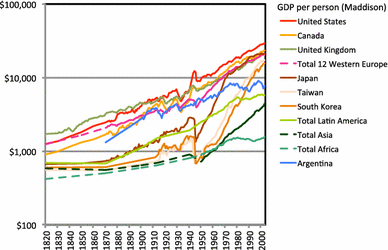
I have no clean explanation for what happened, but I can at least describe what happened after 1930.
In between coups, Argentina stays neutral in both world wars up until the US pressured it into declaring war on the Axis Powers in 1945. But then the Europe part of WWII ended a month later, so they probably didn’t have to do too much. In 1946, Peron takes power.
(Sidenote: why did so many Nazis famously flee to Argentina? Argentina had lots of German immigrants & close ties to Germany. Peron, who’d found Hitler’s ideology appealing since he was a military attaché in Italy during WWII, straight out ordered diplomats and intelligence officers to establish escape routes for Nazis, especially those with military/technical expertise.)
I still don’t know much about Peron. There’s the socialist stuff: nationalized a lot of industries and improved working conditions. There’s the dictator stuff: beating up and firing people to bring them into line, including university teachers (of course) and union leaders that Peron didn’t like. He was really liked for a while, and then very disliked, and got exiled to Spain after a decade of rule.
Then there’s a phase where no one manages to rule successfully, in part because getting approved by both Peronists and anti-Peronists is hard. This 1955-2003 phase reminds me a lot of Korean history around the same time – lots of military coups and assassinations and journalists getting tortured. Whenever I hit this phase in a country’s Wikipedia page it just reads like TV static, interchangeable variable names swinging in and out of scope… even though there’s got to be more than that.
When I first started reading about US Republicans and Democrats I got really confused because either they had 0 major differences or 70. Now that I’ve been in the States for a decade I have a sense for what major visions and underlying values differences they have, but it’d be hard to explain succinctly or in a way that other people will agree with. So something like that has to have been going on with various flavors of anti, sub, and classic Peronism that’s inscrutable to an outsider who’s spending 3 hours on learning about this.
At some point, comically, Peron comes back, wins an election with his wife as vie president, and dies of a heart attack. His wife takes power and does things like empowering the secret police to destroy her enemies, but girlbosses too close to the sun and is ousted after a year.
All this turmoil flattens out somewhat in 2003. I have no idea what went right. They tried Peronism! They tried anti-Peronism! They tried leftist terrorism and rightist terrorism! They tried OG Peron again! They tried Peron’s third wife! They tried nationalization and privatization! They tried protectionism and not-protectionism!
Nestor Kirchner, whose rule coincided with the improvement, had “neo-Keynesian” policies, but who knows if that was it. He didn’t run for reelection but said “try my wife, she’ll do fine”, and so she won the next cycle. Cristina Fernandez de Kirchner did well enough that she was reelected. People didn’t like her successor and brought her back as a vice president, but there were what sound like normal-for-South-America levels of corruption scandals during much of her time in office, and last month she was sentenced to six years in prison and a lifetime ban from holding public office.
I have a number of hypotheses as to why Argentina crashed so hard when it had and has so many prerequisites for success, and they all sound stupid when I write them out, so I won’t. But I will gesture at my confusion and amazement.